Jonathan GarrettAttorney at Law · Memphis (901) 323-3200

Memphis Bankruptcy Lawyer · Chapter 7, Chapter 13 & ForeclosureEliminate Your Debt. Rebuild Your Future.

Helping You Pursue a Secure Tomorrow

It starts sooner than you think. The moment your petition is filed in Memphis, federal law orders your creditors to stop. Not when your case ends, and not when a creditor decides to be reasonable.

11 U.S.C. § 362, the automatic stay

Free consultation Practicing law since 1998 Reachable by phone after hours

What stops when you file

Status: today
  • Collection calls and letters
    Including calls to you at work
    Happening now
  • Wage garnishment
    Money taken before your check reaches you
    Happening now
  • Foreclosure sale
    A scheduled sale of your home
    Happening now
  • Vehicle repossession
    The car you need to get to work
    Happening now
  • Bank account levy
    A frozen or emptied account
    Happening now
  • Collection lawsuits
    Cases already filed against you
    Happening now

The automatic stay is broad, but it is not absolute. Repeat filings, child support, and a few other matters are treated differently. Jonathan will tell you exactly which rules apply to your case before you decide anything.

Areas of practice

Bankruptcy law in Memphis, and the specific problems it solves.

Jonathan Garrett is a Memphis bankruptcy lawyer, and that is the only law he practices. Most people arrive thinking bankruptcy is a single thing. It is not. The right path depends on your income, what you own, and what you are trying to hold onto.

Chapter 7

Discharge the debt and start clean

A short case, often a matter of months, that wipes out most unsecured debt and stops aggressive collection while it runs.

  • Your income is below the Tennessee median, or close to it
  • Most of what you own is protected by exemptions
  • You are not trying to catch up on a mortgage
Debt Chapter 7 commonly clears
  • Credit card balances
  • What you still owe after a vehicle repossession
  • Debt owed to a former landlord
  • Debt from an accident while you were uninsured
  • Personal loans
  • Overdrawn bank accounts
  • Most other unsecured debt
More on Chapter 7 →
Chapter 13

Keep the house, pay on your terms

Sometimes called wage earner bankruptcy. A court-supervised plan, usually three to five years, that lets you catch up on what you are behind on while creditors stand down.

  • You are behind on a mortgage or car and want to keep it
  • Your income is steady enough to support a plan
  • You have assets Chapter 7 would not protect
Reasons people choose Chapter 13
  • A medical crisis put you behind
  • There is a home or a vehicle you intend to keep
  • Your wages are about to be garnished
  • You need a suspended driver license reinstated
  • Credit card interest is outrunning your payments
  • A creditor has sued you or is about to
  • You are carrying medical debt
More on Chapter 13 →
Foreclosure

Stop a sale that is already scheduled

A notice of foreclosure is every homeowner’s worst mail day. In Tennessee the process moves fast, so the calendar is the real problem. Call before the sale date, not after.

  • You have received a notice of sale
  • You are months behind and the lender stopped negotiating
  • You want to stay in the home, not walk away
What filing can do about a foreclosure
  • Halt a scheduled sale the day the petition is filed
  • Chapter 13 can let you cure the missed payments over time and keep the home
  • Chapter 7 stops the sale for a period but does not by itself cure what is past due
  • End the collection calls while you decide which route makes sense
More on foreclosure →
01

Not everyone qualifies

Eligibility turns on your income and the kind of debt you carry. That question gets answered in a consultation, not on a website.

02

There is more than one kind

One chapter erases debt. Another reorganizes it so you can keep what you are behind on. Choosing wrong is the expensive mistake.

03

It stays on your credit for years

A Chapter 7 for up to ten, a Chapter 13 for seven. That is real, and for most people it still beats the alternative. Jonathan will tell you straight which side of that line you are on.

What happens, in order

Nobody shows up at your door. This is a paperwork process.

Here is the actual sequence, so there are no surprises in it.

  1. You call and we talk it through

    Free, private, and no commitment. Bring what you know off the top of your head. You do not need documents to have this conversation.

  2. We gather your numbers

    Income, debts, what you own, what you owe on it. Jonathan tells you which chapter fits and what it will cost before you sign anything.

  3. The petition is filed

    This is the moment the automatic stay begins. Creditors are notified by the court. The calls stop here.

  4. The meeting of creditors

    A short meeting with the trustee, roughly a month later. Jonathan is with you. In most consumer cases no creditor shows up at all.

  5. Discharge, or your plan begins

    In Chapter 7, the qualifying debt is discharged. In Chapter 13, you make one plan payment each month and the court holds creditors back the whole time.

Jonathan Garrett, bankruptcy attorney in Memphis, Tennessee
Jonathan Garrett
Attorney at Law

About Jonathan

He watched people lose everything. At 36, he changed careers because of it.

Before law, Jonathan Garrett worked in the oil industry. Blue collar, on the job, alongside people who lost everything they had when the work dried up. Steady, careful people, undone by something none of them caused. That is not an abstraction to him.

At 36 he decided to chart a different course, went to the University of Memphis School of Law, and has practiced law since 1998. In 2002 he left a corporate law firm to go out on his own, so the work would be for regular Tennesseans rather than corporate clients. He has been doing exactly that ever since.

I want my clients to have peace of mind and feel like they are being treated like family.

Jonathan Garrett

Today the practice is Chapter 7, Chapter 13, and foreclosure. As a bankruptcy attorney he represents individuals and families across Memphis, Germantown, Arlington, Covington, and Shelby, Tipton, and Fayette counties. You will not be handed to a paralegal and left to guess. When you have a question about your case, you ask Jonathan.

From clients

What Memphis clients say after it is over.

Mr. Garrett was very friendly and understanding in my situation. He took time out to break down the whole process. All of his staff members were very nice and helpful.

Samantha C.

Love this office! They are very friendly, get you on the right track and help you to succeed after your case. I was told about every rule and everything that I didn't know before.

Christiana B.

They are very understanding and extremely helpful in understanding what is needed in your case. They explained everything that was needing to be done.

David T.

Free consultation with a Memphis bankruptcy lawyer

Tell us what is happening.

A few lines is enough. If there is a sale date, a garnishment, or a court date on the calendar, say so and we will move you up.

Sending this form does not create an attorney-client relationship. Please do not include confidential details until Jonathan has confirmed he can represent you.

Office
2670 Union Ave Ext, Suite 1220
Memphis, TN 38112
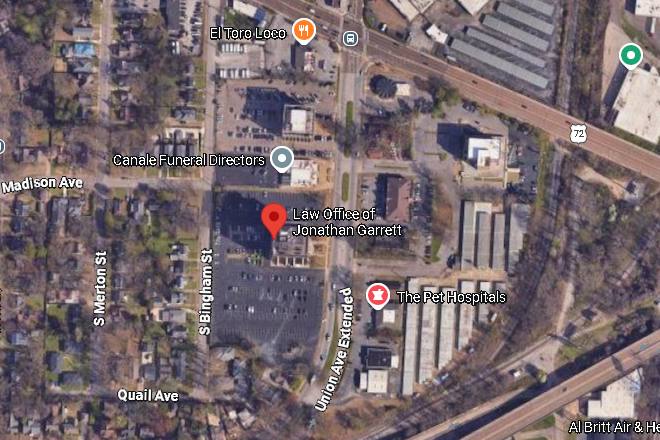
Satellite map of the office at 2670 Union Ave Ext, Suite 1220, Memphis, Tennessee Get directions
Phone
(901) 323-3200
Hours
Mon9:00 AM to 5:00 PM Tue9:00 AM to 5:00 PM Wed9:00 AM to 5:00 PM Thu9:00 AM to 5:00 PM Fri9:00 AM to 5:00 PM

Reachable by phone after hours.

Areas served
Memphis, Germantown, Arlington, Covington, and Shelby, Tipton, and Fayette counties. Cases are filed in the U.S. Bankruptcy Court for the Western District of Tennessee.
Call now Free consultation